For towns, villages and regional districts in British Columbia
AI that answers your town's phone after hours
Residents call or chat about potholes, water, garbage, bylaw and taxes. The line answers from your own pages, logs a ticket for staff, and hands off to a person when needed. Data stays in Canada. You see it working before anything goes live.
- Fixed price, agreed first
- Staff review every conversation
- Hosted in Canada
- You own it
Built by Westcode.io in Kelowna and Vancouver. 15 years building websites and web apps.
The front counter is already full
Same calls as a city. Far fewer people to take them.
In a town of 2,000 to 40,000, the same people take service requests, answer "when is garbage day?", process dog licences, and field after-hours calls that are not emergencies. Seasonal spikes make it worse: snow, water restrictions, wildfire information, tax deadlines and building permits.
The City of Kelowna is currently procuring a City Services Hub to bring service requests into one place. Smaller communities get the same kinds of calls, with a much smaller team to take them.
-
After hours, the phone still rings
Town Hall closes. Residents still call about a street light, a missed pickup or a water issue that is not an emergency. Someone either wakes up, or the voicemail waits until morning.
-
The same questions, every week
Garbage week, dog licences, tax due dates, watering rules, "how do I apply for a permit?" Your website already has the answers. People call because they cannot find them.
-
Requests live in too many places
Phone notes, Facebook messages, emails and "someone told the cashier." Things get lost, and residents call back to ask if anyone saw their note.
-
Emergencies must stay with 911
A service line is for non-emergency questions and requests. Real emergencies go to 911, and your on-call public works number stays in place for true after-hours emergencies.
What we can build
The jobs a service line can take off your desk
Start with after-hours phone and web, plus the questions your residents already ask. Add more later, once staff trust the queue.
-
After-hours phone line
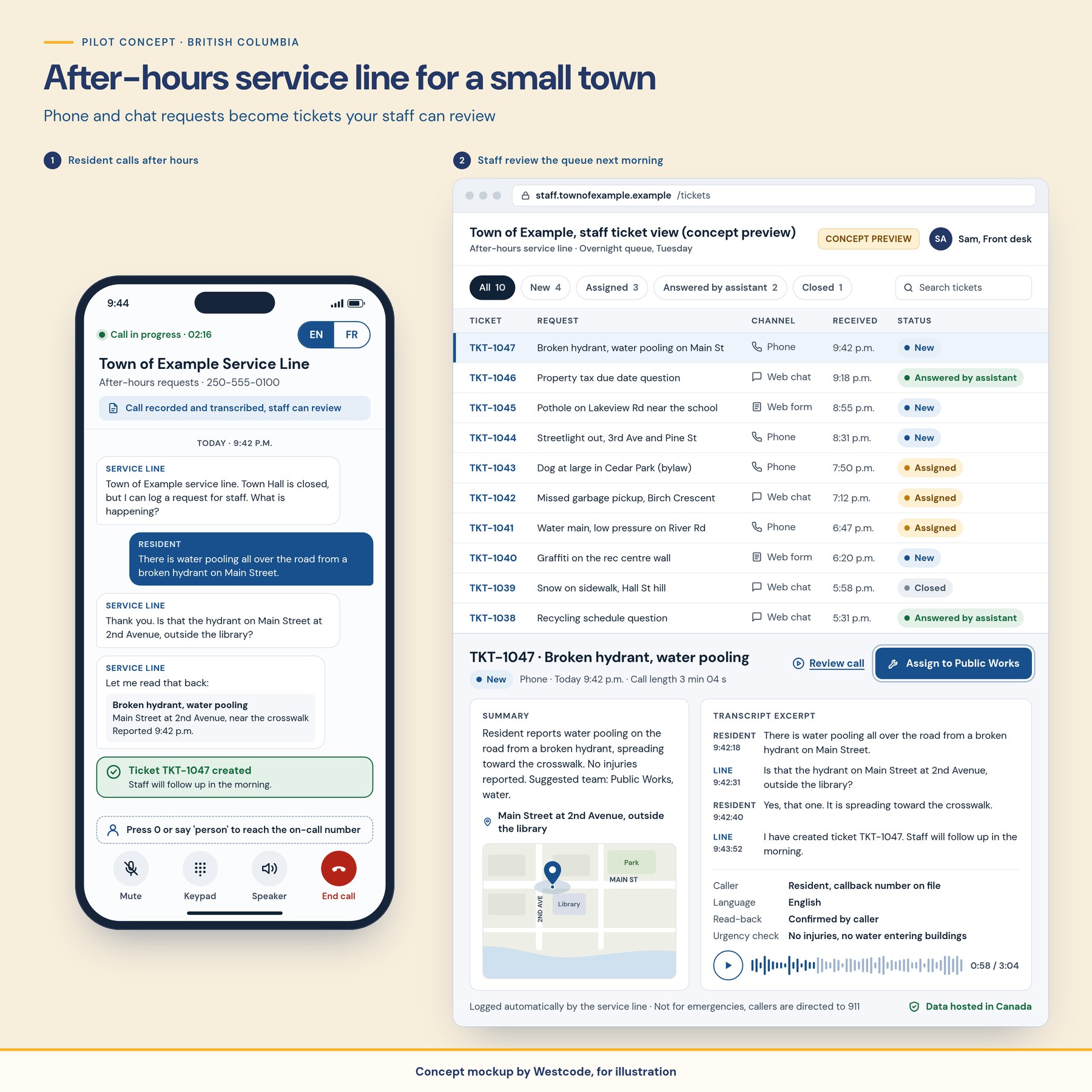
When Town Hall is closed, residents can still report a problem or ask a common question. The line records the call, reads the request back, and creates a ticket for the morning. Staff can listen to the recording. Callers can press 0 or say "person" to reach the on-call number you choose.
-
Requests that become tickets
Potholes, street lights, water leaks, missed garbage, graffiti and bylaw complaints land in one queue, from phone, web chat or a simple form. Staff assign them and close them. Residents do not have to guess which department to email.
-
Answers from your own website
A chat on your site, and the same knowledge on the phone, answers from pages and FAQs you approve: hours, fees, schedules, bylaws. If it is not in your content, it says so and offers a ticket or a person. It does not invent policy.
-
Seasonal and official notices
Snow clearing, water restrictions, boil-water notices, and evacuation information you have already published. The line can read the current notice and point people to your official channels. It is not 911, and it does not replace your emergency notification system.
-
Taxes, utilities and garbage
"When is my property tax due?", "How do I pay my utility bill?", "Which week is recycling?" Answers come from your published dates and schedules. Personal account balances stay behind the systems you already use.
-
Bylaw complaint intake
Noise, parking, unkempt properties and similar complaints are taken with an address, a description and a callback number, then routed to bylaw staff. The assistant does not decide if a bylaw was broken.
-
Permits and licences
Dog licences, building-permit questions, "what do I need for a deck?" The assistant walks people through your published requirements and can start an intake form so staff receive a complete package, not a half-finished email.
-
A staff knowledge assistant
New clerks and summer students can ask internal questions about process, contacts and "how we usually handle this," using documents you approve. Knowledge stays available when someone is on vacation.
-
Council agendas and draft minutes
After a meeting, we can turn an audio recording into a draft summary and draft minutes for the clerk to edit. Nothing is published until a person signs off.
-
English and French
The phone and chat can serve residents in English and French, with a clear path to a person.
See it
A morning queue, not a voicemail pile
A resident reports a broken hydrant after hours. Staff open a ticket with the transcript, the location and the recording waiting for them.
How a pilot works
Small, fixed‑price, and yours
A 60 to 90 day pilot on a tight first scope. You review working previews. Residents do not see anything until you are ready.
A 20-minute call. We look at how residents reach you today.
You pick a first scope: after-hours phone and web, plus 5 to 15 request types.
We build on content you approve. You review working previews along the way.
A fixed-price pilot for 60 to 90 days. You see it working before residents do.
Staff can review every call and chat. Recordings and transcripts stay available.
Data is hosted in Canada. The interface is built toward WCAG 2.1 AA, in English and French.
If you keep it, the pilot fee is credited toward year one. You own what we build.
Questions
The things a CAO asks first
What about privacy and FOIPPA?
BC municipalities are public bodies under FOIPPA. We host the application, recordings, transcripts and logs in Canada, and we help you with the privacy notes a privacy impact assessment needs. City data is not used to train public AI models.
What if the assistant gets something wrong?
It answers from content you approve. If it is unsure, it says so and offers a ticket or a person. Staff can review every conversation. You decide what it is allowed to do without a human.
What about real emergencies?
Emergencies go to 911. The service line tells callers that at the start, and it is not a replacement for your on-call public works number or your emergency notification tools.
Do we need a 311 number?
No. Most small BC communities do not have 311. This works on your existing civic number, a new local or toll-free line, and your website.
How much does it cost?
Fixed-price, quoted up front, after we understand your volume and the request types you want in the first pilot. No surprise hourly bills.
Who owns it?
You do. Your content, your data, and the product we build for you.
How quickly can we try this?
After a short discovery, a focused pilot typically runs 60 to 90 days.
Who will we be talking to?
The people who design and build the work. There is no sales team in between, from the first call to handover.
Ready to see what this would look like for your community?
A 20-minute call is enough to look at how residents reach you today and whether a pilot would save your front counter time.